What are you running after?
The summer I turned seventeen, I ran forty-five minutes a day. No goal, no race. Because it felt good.
The year before, I’d lost twenty kilos. My body had changed, obviously, but that wasn’t the important part. I’d found something else: a confidence I’d never had, my first romantic relationships, and one thing I hadn’t seen coming at all. Three people around me started too, and their lives changed. I’d found out what it feels like to inspire someone. And what it feels like to be seen.
That summer, a guy five years older than me told me two things. The first was that he admired my balance: sports, school, parties, still taking things seriously, all of it holding together. The second, as a joke: “so what are you running after?”
It made me laugh at the time. The answer seemed obvious. After nothing. I was running, that was all.
Forty-three years later, I still run. And the question is still there. It just stopped being funny.
What Coach Bennett says
Chris Bennett coaches runners at Nike. His message fits in one sentence, and he’s been saying it for years: this is about running, this is not about running.
Resist the urge to simplify that. The easy reading is that running is just a pretext, that the real subject sits somewhere else, in your head or in your life. Bennett doesn’t say that. He says both, at the same time, with neither one on top.
The running is real. The legs burn for real. The clock doesn’t lie. And it’s precisely because the first level is real that the second one can exist. You can’t run symbolically. The body doesn’t buy stories. You only get to the second thing by actually doing the first.
Every kind of run has its equivalent
This is where it gets specific, and it’s the part most people miss.
Training is the days you put in the work with nobody watching and nothing to show for it. You already know where that sits in your life.
The speed session is the day you go after something that scares you a little. You know it’s going to hurt. You go anyway. Push, ease off, walk, start again.
The recovery run is the slow one everybody wants to skip because it produces nothing you can measure. Except it’s what makes the rest possible. Skip it enough times and you get hurt. You know where that one sits in your life too, and you probably know you’re skipping it.
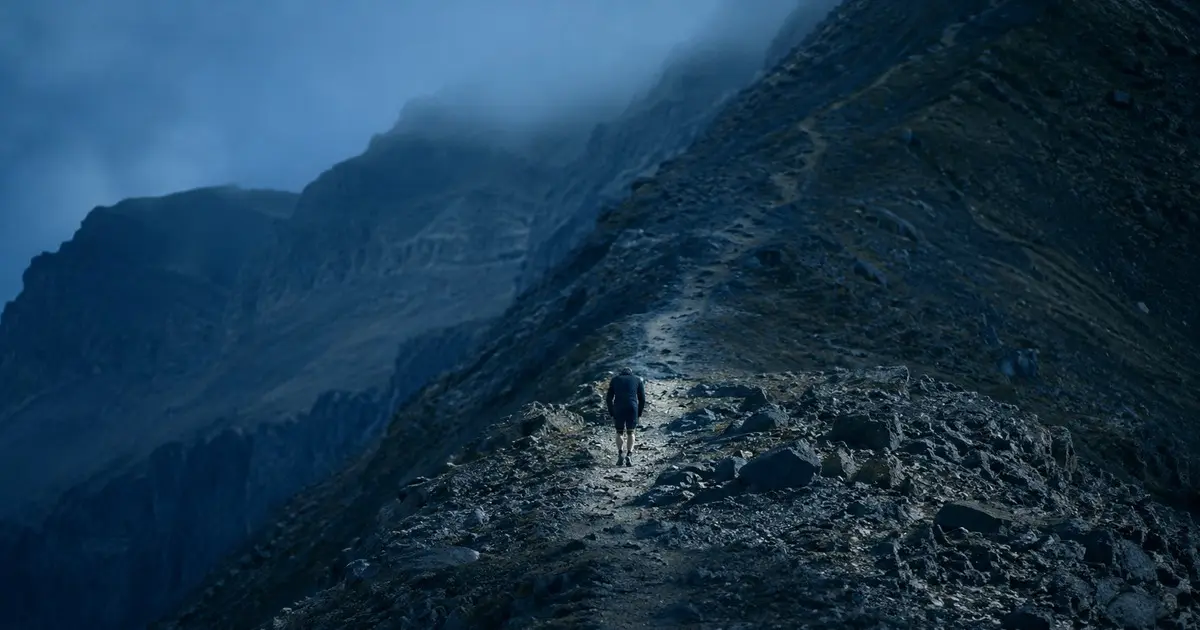
Trail running is the foot of the climb you simply cannot run. We’ll come back to that one, because it’s where I learned the most.
Race day is the day it counts and there’s nothing left to add. It’s either done or it isn’t.
And then there’s the run you didn’t want to do, the one you do anyway, in the rain, with nobody to see it. That one changes nothing in your numbers. It changes who you are. Every run changes who you are.
How you handle each of those in running is how you handle them in life. Not a metaphor. Same person, same attitude, in a setting where it shows. That’s what running teaches you: it puts in plain sight what stays blurred everywhere else.
What the long distances teach
The foot of the climb, then. The moment you have to accept you can’t run it, and start walking.
For years I took that as quitting. Walking meant giving up. Courtney Dauwalter is probably the best ultra runner in the world, and what I took from her is disarmingly simple: what matters is that you keep moving. If you have to walk at some point, walk.
That set me free. Not from a rule of the sport, but from one I’d imposed on myself. The ones who refuse to walk don’t get to the top faster. They don’t get to the top.
She says another thing that stuck with me. On a long race you can game out every scenario, plan every aid station, prepare for heat, cold, night, your stomach turning on you. And what actually happens is the thing you never planned for.
Which doesn’t make preparation pointless. It means preparation isn’t doing what you think it’s doing. It doesn’t shield you from the unexpected, it puts you in shape to meet it without coming apart. What decides your finish is what you do once the plan is gone. Adapting is worth more than the plan was.
Look how many people spend their lives perfecting the plan.
UTMB 2025 makes the point better than any argument. Two thousand four hundred ninety-two starters, one thousand six hundred sixty-four finishers. A third of the field never made it back, and that third included almost every favorite. François D’Haene, four-time winner, stopped at kilometer seventy-two. Others dropped out at a hundred twenty-eight, at a hundred forty-six, sitting in the top five when they did.
So on paper, the last finisher, walking back into Chamonix after more than forty-five hours, ranks ahead of a man who’s won that race four times. Few sports let the order flip that completely in a single night.
Those rankings mean nothing and they mean everything. They tell you nothing about how good the runners are. They tell you everything about what actually gets people to the finish.
That same year, Courtney Dauwalter had a nightmare of a race. She ended up deep in trouble, nowhere near what she’d come for. She kept going. Tenth. What matters is that you keep moving.
That’s exactly what this is not about running means.
Why the first level eats everything
There’s a mechanical reason we only ever talk in numbers. The first level can be measured. It’s got units, curves, apps that plot them. You can optimize it, compare it, post it.
And that’s where it turns on you. Your sense of your own worth ends up resting entirely on that level. You chase the faster time, the longer distance, the number worth showing. On the day it doesn’t come, there’s nothing left to celebrate. Even though the session happened, with everything it asked of you.
The second level has no units. What happens at kilometer twenty-five, when your head starts bargaining and something else decides to keep going, no watch is measuring that. Whatever quietly works itself out on a long run after a rough week shows up nowhere in the summary. It’s the level nobody thinks to celebrate at the finish, and it’s usually the one you grow from.
So it becomes invisible, even to the person living it. He’s been running fifteen years, he could talk you through every pair of shoes he’s owned, and if you ask him what running actually gives him, he’ll tell you about his cardio.
He isn’t holding back. He doesn’t know. He’s never needed to know.
The day it breaks
Until the numbers stop going up. An injury, age, a stretch of work that makes training impossible. And plenty of people stop.
What they describe then isn’t a rational decision. It’s a loss. Not missing a hobby, which would be normal enough. Something bigger goes out with it, and they can’t say what.
That something was the “and.” It had been there from the start. Nobody ever named it, so when the measurable half collapsed, it took everything with it.
This goes well beyond running
You may not be a runner. The mechanism doesn’t change. Someone working fourteen-hour days will tell you about revenue and workload. That’s their “about running.” What they’re actually after, they almost never put into words.
The problem isn’t not knowing. The problem is that we optimize the visible level and think we’re dealing with the real subject. You run faster when the question was never speed. You work more when the question was never how much work. The counter climbs, and nothing shifts. That’s how people burn themselves out without understanding why. They’re not short on effort. They’re pouring all of it into the half of the sentence they can see.
What that guy had seen
He told me two things that day, and it took me years to notice they didn’t fit together. He admired my balance, and in the same breath he asked what I was running after. You don’t question why someone runs when their life looks balanced to you. Unless you’ve picked up on something the balance wasn’t showing.
He was right, and he had no idea. Neither did I.
The literal sense of the question is almost a trap. “After what” implies a chase, a target, something out in front. The honest answer, most of the time, isn’t in front. It’s underneath.
At seventeen, I wasn’t running after a number on the scale. That was already settled. I was running so I’d never be that person again. That’s not a chase. That’s standing watch. And standing watch doesn’t look like anything from the outside. It looks like discipline. It even looks like balance.
I still run today, and it isn’t that anymore. I know what it gives me outside of running. Being able to dig in when digging in is what’s needed. Being able to walk when it gets too hard, at work as much as on a mountain, without filing it under failure. Being able to recover after an effort instead of stacking the next one on top until something gives. The long trails taught me that, and none of it shows up on a watch.
The difference between seventeen and now isn’t in the mileage. It’s in knowing what comes after the “and.”
So the question still stands, and it isn’t funny anymore.
You know what you’re measuring right now. The number that’s on your mind, the target you set yourself, the thing you’ve been forcing for months. That’s your “about running.”
And after the “and,” what’s there?
Sometimes what's missing isn't more effort on the level you can see, but a look at the one you can't measure. That's exactly what the Focal Shift AI Advisor is for: a conversation, at any hour, that isn't trying to optimize anything, just to shed light on what you're not looking at. And if you'd rather talk it through, the first 30-minute call is free.