Curious for nothing
A five-year-old who finds a puddle doesn’t stop to ask whether jumping in is worthwhile. He jumps, he watches what happens, he does it again, changing one thing. Harder. On one foot. Backward, to see. And one last time because the first one didn’t count.
No one explained the method to him. He tests, he adjusts. And most of all: he’s having a blast.
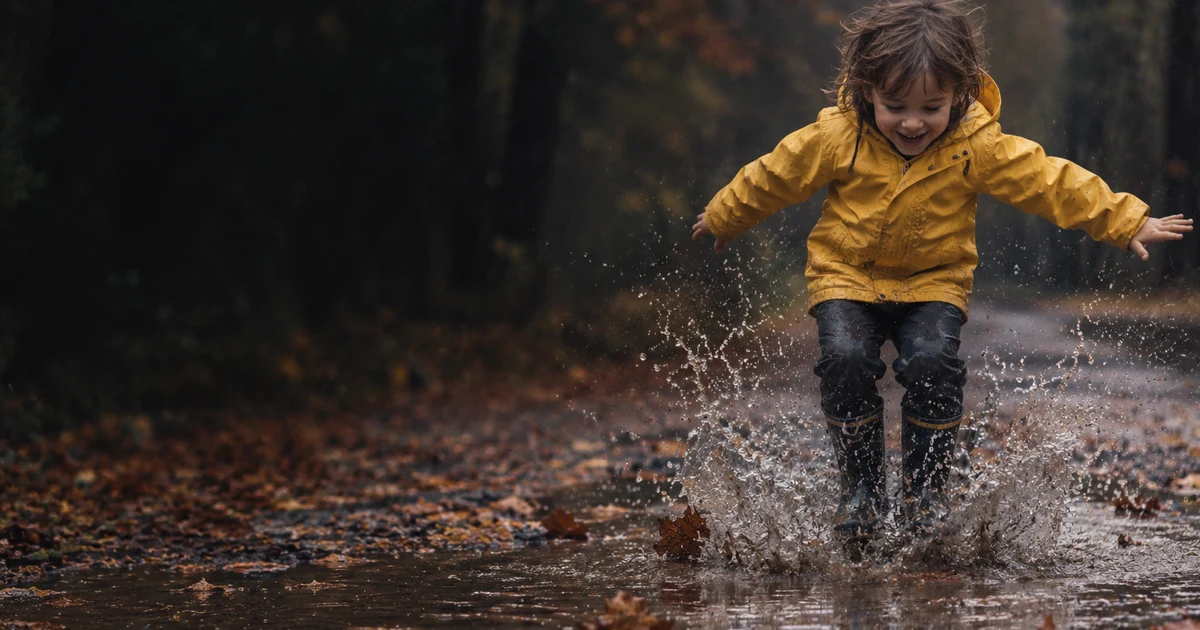
Twenty-five years later, the same person walks around the puddle and goes home.
Somewhere between the two, being curious stopped being a game and became a task. We’re still curious, but with a purpose. We do our research. We compare fifteen models before buying. We read three articles on a topic because we need to sound informed in a meeting. Useful. It pays off. And completely joyless.
Todd Kashdan, who has studied curiosity for twenty years, measured its different forms across several thousand people. The one that best predicts well-being has a name that makes you smile: joyous exploration. Not the anxious hunt for a missing piece of information. The sheer pleasure of finding the world interesting.
Joyous exploration doesn’t ask permission. It serves no purpose. That’s exactly what makes it work.
There’s also a rather unfair side effect. A team of neuroscientists showed that while you’re intrigued by something, whatever else turns up at that moment sticks too, including things with no connection at all to what interested you. Curiosity rubs off. Get caught up in how piano strings are made and you’ll walk away with things you weren’t looking for.
No child knows this. Every child benefits from it.
The moment the puddle becomes off-limits
Susan Engel, a developmental psychologist, spent several months observing elementary school classrooms. Her aim was to compare curiosity rates from one class to another: which children ask questions, which teachers encourage them.
She couldn’t run the comparison. There was almost no curiosity to measure anywhere.
Her counts give you a sense of how steep the drop is. In kindergarten she records roughly two episodes of curiosity per two-hour stretch. An episode is a question asked, a gaze lingering on something, a hand reaching for an object to see how it works. Twice in two hours. By fifth grade it drops below once every two hours.
Expect the right answers from them for long enough and you strip out the curiosity they came in with. A question that strays from the syllabus costs everyone time. The right answer earns points, the right question earns none. After a few years the message has landed: the puddle is off-topic.
The rest of life just keeps the rule in place.
What blocks us isn’t age
What happens to adults comes down to a build-up of conclusions.
We’ve filed things away. That colleague is like that. This kind of project always ends the same way. Me, I’m not someone who. Every sentence like that is a puddle walked around.
Most of those conclusions are reasonable, they come from real experience. We’ve simply stopped testing them. A child who decides that water splashes will jump back in to check anyway. An adult who decides their job is a dead end checks nothing at all — they build their life around it.
Except it never fully goes out
Two researchers, Christopher Hsee and Bowen Ruan, sat fifty-four students in a room with ten trick pens on the table. Some deliver a small electric shock when clicked. The students are told the pens are left over from an earlier experiment, and that they can play with them while they wait for the real study to begin.
For some of them, the pens are color-coded: you know which ones sting. They click three on average. Two of those sting.
For the others, all the pens look identical. No way to tell. They click five.
Grown adults, alone in a room, deliberately shocking their own fingers. No audience and no reason whatsoever. The ones who knew did it anyway, and the ones who didn’t know did it more.
Thirty years of being sensible doesn’t survive ten minutes with a pen when you don’t know what it does.
The researchers saw a warning in this. It can also be read the other way around.
The question doesn’t have to be a good one
An objection tends to surface here: where to start, when you’re going in circles and don’t even know what to ask.
The quality of the question doesn’t matter. The child at the puddle isn’t forming an elegant hypothesis. He wonders what happens if he jumps harder. It’s a stupid question and it produces an immediate result.
A clumsy question, slightly off, still sets something moving. It makes you look elsewhere for two seconds, and two seconds is sometimes enough. Waiting for the right question means standing at the edge figuring out the best way to jump.
Puddles you can jump in today
There’s nothing to get back, really. Just stop walking around the puddles.
Ask a question of someone whose answer you’re sure you already know. Go home a different way, one you’ve never taken, for no reason. Ask someone close to you what they actually thought of a decision you made six months ago. Order the dish you’ve been avoiding for three years. Open the book someone gave you when they’d gotten your taste completely wrong. Ask your quietest colleague what they’d do in your position.
Nothing to gain from it, no one to report back to.
They’re puddles.
Sometimes nothing happens and you’ve lost four minutes. Sometimes something shifts, and no amount of thinking it through from your armchair would ever have gotten you there.
That’s why Focal Shift doesn’t arrive with answers, but with living questions. An answer closes the puddle. A question makes you want to jump in and see, and it’s that movement that makes situations workable, even the ones you’d written off.
When was the last time you were curious about something that was no use to you at all?
Sources
Kashdan, T. B. et al. (2018). The five-dimensional curiosity scale. Journal of Research in Personality, 73, 130-149.
Gruber, M. J., Gelman, B. D. & Ranganath, C. (2014). States of Curiosity Modulate Hippocampus-Dependent Learning via the Dopaminergic Circuit. Neuron, 84(2), 486-496.
Engel, S. (2015). The Hungry Mind: The Origins of Curiosity in Childhood. Harvard University Press.
Hsee, C. K. & Ruan, B. (2016). The Pandora Effect: The Power and Peril of Curiosity. Psychological Science, 27(5), 659-666.