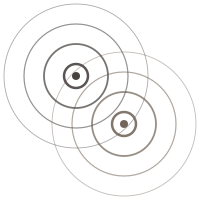
Quantum thinking versus binary thinking
Everyone’s talking about quantum computing. At conferences, in the press, in technology roadmaps. It’s presented as the next revolution. And to understand why, you only need to understand one thing.
A classical computer works with bits. Each bit is either 0 or 1. On or off. Yes or no. To solve a problem, it tests each possibility one at a time. It’s fast, but it’s sequential. One thing at a time.
A quantum computer works with qubits. And a qubit can be 0, 1, or both at the same time. That’s called superposition. Instead of trying each possibility one by one, the machine works with multiple simultaneous states and uses their interactions to surface an answer. It holds several realities in parallel before settling on one.
This is presented as extraordinary. As an unprecedented technological leap.
Except it looks remarkably like something you’ve been doing since the day you were born.
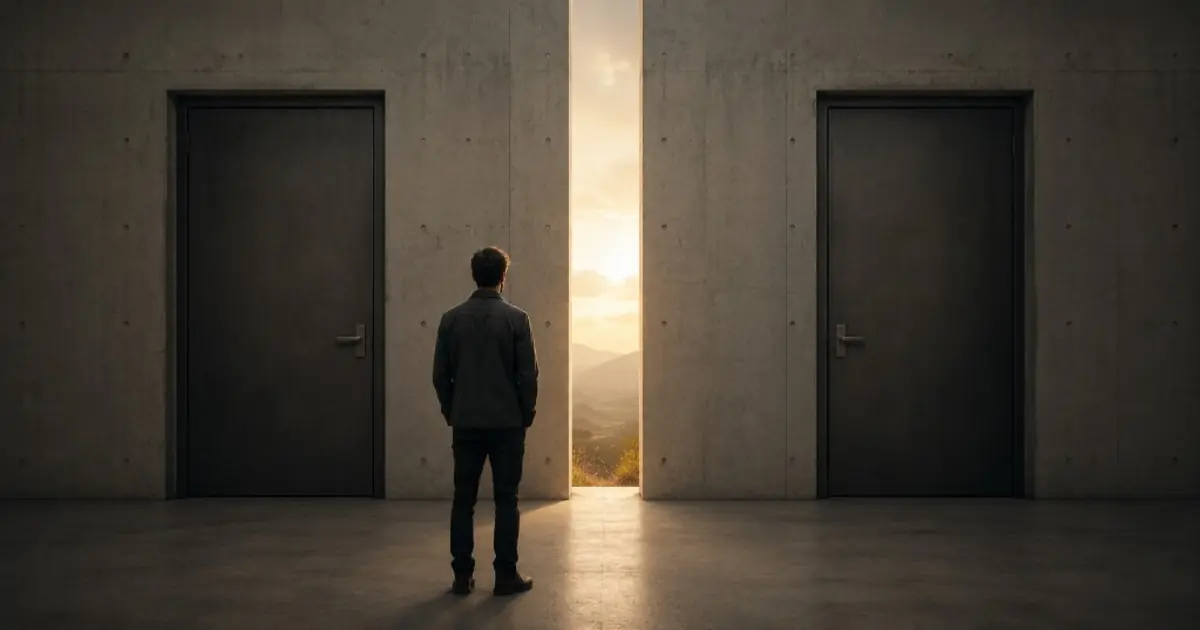
The original hardware
A three-year-old wants to leave and stay at the same time. He loves his mother and he’s furious with her. He’s afraid of the dark and fascinated by it. These aren’t contradictions. These aren’t signs of confusion. This is superposition.
The child doesn’t “choose” between two states. He holds them together. He lives in several realities in parallel, and it doesn’t bother him at all. His brain is quantum by default.
And then the instructions arrive.
“Is it good or bad?” “Do you want it or not?” “What’s your answer?” “Choose.”
Home, school, the people around you. From early childhood, everything pushes in the same direction: reduce. Cut it down to one. We install a binary operating system on quantum hardware. And we call that growing up.
“What do you want to be when you grow up?” One answer. “Are you for or against?” Two boxes. “Have an opinion.” One opinion per topic, please.
The problem isn’t that binary thinking exists. It’s useful. It lets you decide quickly and move forward. The problem is that it’s taught as if it were the only way to think. As if not choosing meant not thinking.
What it costs
You know the moment. Someone asks you what you want. And the real answer is: several things at the same time, some of which contradict each other. But that answer doesn’t count. So you pick one. Or you say “I don’t know,” which is often untrue. You do know. You know a lot, actually. What you don’t know is how to fit what you know into a binary answer.
You love your job and it’s suffocating you. You want to leave and you have good reasons to stay. You can see that a relationship isn’t working anymore and you can also see what it could become. None of this is indecision. It’s information.
But the world around you treats it as a problem to solve. “You need to make up your mind.” “You can’t want both.” “It’s one or the other.”
Every time someone says that to you, they’re doing exactly what we do to a three-year-old: forcing a quantum state into a binary output. Collapsing the superposition. Reducing the possibilities to one.
And sometimes, the real answer isn’t in the 0 or the 1.
What our machines say about us
The technologies we’re building right now tell us something about ourselves. Artificial intelligence is directly inspired by the human brain. Artificial neural networks are called that for a reason. And large language models produce probabilistic outputs. Every word they generate comes from weighing thousands of possibilities at once. Their output isn’t yes or no. It’s a spectrum.
Quantum computing comes from somewhere else entirely. It runs on particle physics, not on the biology of the brain. But the structure is the same: holding multiple states simultaneously instead of reducing to one. Superposition. It’s the same word, and it’s no coincidence that it describes so well what happens in your head when you “can’t seem to choose.”
And these two technologies draw their power from the same principle. They don’t handle questions alone. AI runs millions of parameters in parallel. Quantum processors only become powerful when their qubits are entangled, meaning connected, linked, so that the state of one instantly influences the state of the others. In both cases, it’s the network that thinks. It’s the whole that finds the answer.
Not a lone processor off in a corner “thinking it through properly.”
We inspired AI. And we built quantum machines that, by a completely different route, do something we were already doing. What these technologies have in common is what they remind us of: you don’t handle complexity alone.
The question that remains
We inspired machines that handle complexity by collaborating. Then we find ourselves alone, late at night, trying to “think it through properly” by forcing our thoughts into yes or no.
There may be something to learn from what we ourselves inspired. Not the speed. Not the processing power. The principle: don’t handle a complex question alone.
Maybe it’s our turn to take inspiration from them.
That’s why Focal Shift exists.
When someone shows up with a question that “doesn’t fit in any box,” it’s rarely because they lack information. It’s because the answer isn’t binary, and everything around them insists that it should be. The in-between states, the ones they held naturally before they were taught to choose, are still there. Buried. Not gone. Just made invisible.
Focal Shift offers perspectives. Not to add options. To give you back the ones that were already there and got collapsed too fast. Each different perspective reopens a state that binary thinking had closed.
The AI Advisor works on this principle. It doesn’t reduce. It asks questions that leave the superposition intact. At any hour. Including the one when you’re alone with a question nobody around you really understands.